
For SaaS companies in growth mode, HubSpot often starts as a smart, scrappy choice. You spin it up quickly, connect a few tools, launch campaigns, and move fast. But as revenue grows, teams multiply, and your go-to-market motion becomes more complex, HubSpot stops being “just a tool” and starts becoming infrastructure. That’s usually the moment technical and operational leaders – RevOps, Marketing Ops, and even engineering, feel the friction: brittle workflows, unclear data ownership, mounting technical debt, and a platform that can do everything, but somehow isn’t doing the right things.
This is where the real question emerges, not can we manage HubSpot ourselves, but should we? More specifically, why hire a HubSpot partner instead of continuing with a DIY approach that technically works, but might slow you down?

The purpose of this guide is to give you a clear, practical decision-making framework. Not a sales pitch, and not a generic “agencies are great” argument, but a strategic lens to help you understand when hiring a HubSpot agency becomes a necessity for scale, not a nice-to-have. We’ll break down the tradeoffs between DIY and agency-led implementations, the hidden costs SaaS teams often overlook, and the scenarios where a specialized HubSpot partner delivers outsized ROI.
In the sections ahead, we’ll cover:
- What a HubSpot Solutions Partner actually does, and why SaaS companies need a different kind of expertise
- The warning signs that your DIY HubSpot setup is holding growth back
- The strategic value a SaaS-focused partner brings beyond basic implementation and automation
- How to evaluate and choose the right HubSpot agency for a complex, revenue-driven tech business
If you’re weighing why to hire a HubSpot partner versus keeping everything in-house, this guide is designed to help you make that call with confidence.
What Is a HubSpot Solutions Partner (and Why Does It Matter for SaaS)?
A HubSpot Solutions Partner is an agency that’s been officially certified by HubSpot to implement, customize, and scale the platform for growing businesses. These partners undergo product training, maintain active certifications across HubSpot hubs, and receive access to advanced tooling, early feature releases, and direct support channels inside the HubSpot ecosystem.
But for SaaS companies, the title alone isn’t the point. The real reason to hire a HubSpot partner is the difference between knowing HubSpot and knowing how SaaS businesses grow inside HubSpot.
A generalist agency may be great at setting up forms, email campaigns, and basic automation. A SaaS-focused HubSpot partner, on the other hand, designs the platform around revenue mechanics: MRR, churn, LTV, expansion, product-qualified leads (PQLs), and multi-touch attribution across a longer, more complex buyer journey. That difference shows up in how pipelines are modeled, how lifecycle stages are defined, and how data flows between marketing, sales, product, and customer success.
For SaaS teams, hiring a HubSpot partner isn’t about outsourcing execution, it’s about bringing in specialists who understand both the platform and the business model it needs to support.
The Crossroads for Growth: When the DIY Approach Hits Its Limits
For most SaaS companies, HubSpot adoption doesn’t start with a big strategic bet. It starts with momentum. A small team, aggressive growth targets, and the need to move fast. HubSpot is flexible, intuitive, and powerful enough that a DIY setup feels not just possible, but smart.
And for a while, it is.
But as the business scales, that early configuration quietly becomes the foundation everything else depends on: reporting, revenue forecasting, attribution, lifecycle stages, and how teams across marketing, sales, product, and customer success make decisions. This is the inflection point where many SaaS leaders are forced to pause and reassess, not because HubSpot isn’t working, but because it’s working in ways that no longer match the business.
Additionally, HubSpot releases many updates and betas each week, and unless someone on the team is fully focused on them, it’s hard to keep up. This means your platform may fall behind in terms of capabilities.
This section walks through that common journey: from a promising self-implementation to the operational friction that eventually raises the question – why hire a HubSpot partner at this stage of growth?
The Initial Appeal of Self-Implementation
Starting with a DIY HubSpot setup makes a lot of sense. It’s cost-effective, gives internal teams hands-on familiarity with the platform, and offers a sense of control during an early, fast-moving phase. Marketing can launch quickly, sales gets visibility into leads, and RevOps can iterate without external dependencies.
For early-stage SaaS teams, self-implementation isn’t a mistake, it’s often the right call. The challenge is that HubSpot configurations made for speed rarely age well when the business model, team structure, and data complexity evolve.
Recognizing the Symptoms of Outgrowing Your Setup
The shift from “good enough” to “actively holding us back” usually shows up as a series of operational red flags. For SaaS companies, these symptoms are often hard to ignore:
- Messy or unreliable data that makes it impossible to trust MRR, churn, or funnel reports
- Broken or overly complex workflows that cause lead leakage, duplicate records, or inconsistent lifecycle stages
- Inability to incorporate product usage data into HubSpot, limiting PQL scoring and lifecycle progression
- Reports that don’t reflect a subscription business, relying on linear funnel logic instead of recurring revenue dynamics
- Manual workarounds in spreadsheets or external tools because HubSpot can’t answer basic growth questions cleanly
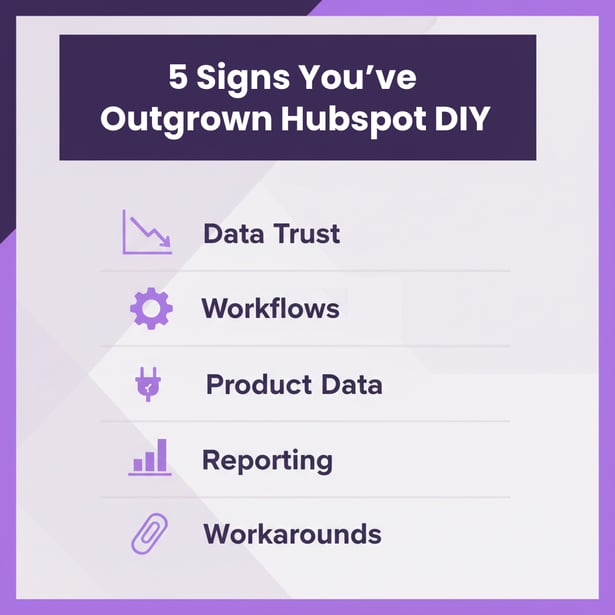
When these issues start stacking up, the problem usually isn’t execution, it’s architecture. And that’s the moment many SaaS teams realize the question is no longer how do we fix this ourselves, but should we hire a HubSpot partner who’s built for scale, not just setup.
Beyond Standard Benefits: The Critical Value of a Partner for SaaS
Yes, hiring a HubSpot partner can save time. Yes, it gives you access to deeper platform expertise. And yes, it can reduce the learning curve for internal teams. You’ll see these benefits highlighted by almost every HubSpot agency, and they’re all true, but they’re not why scaling SaaS companies ultimately decide to hire a HubSpot partner.
For a growing tech company, HubSpot isn’t a marketing tool. It’s a revenue system. And the real risk of getting it wrong isn’t inefficiency, it’s distorted data, broken revenue signals, and decisions made on a flawed foundation.
This is where a specialized HubSpot agency earns its keep: not by “running campaigns,” but by designing, correcting, and future-proofing the revenue engine your business runs on.
Strategic RevOps Architecture, Not Just CRM Setup
A basic HubSpot setup focuses on surface-level functionality: contacts, deals, pipelines, email automation, and dashboards that look good in weekly meetings. A RevOps-driven HubSpot architecture, on the other hand, is designed around how a SaaS business actually makes and retains money.
When SaaS companies hire a HubSpot partner, they’re not paying for CRM configuration, they’re investing in a unified revenue model.
A RevOps-focused partner designs HubSpot as a single source of truth across marketing, sales, and customer success. That means aligning lifecycle stages, pipelines, and objects so that MQLs, SQLs, opportunities, customers, expansions, and churn are all part of one coherent system, not three disconnected views of reality.
In practice, this often includes:
- Custom objects to track subscriptions, plans, MRR, ARR, churn, and expansion revenue
- Deal structures that support renewals, upsells, and multi-product subscriptions
- Lifecycle logic that reflects product-qualified leads (PQLs) and post-sale engagement, not just lead → deal → closed-won
- Revenue reporting that ties pipeline activity directly to recurring revenue outcomes
Without this architectural layer, HubSpot may technically “work,” but it won’t tell you what you actually need to know to scale.
Mastering Complex Integrations: Connecting Product Data & APIs
One of the fastest ways SaaS teams outgrow a DIY HubSpot setup is when product data enters the picture.
Marketing engagement alone isn’t enough to qualify leads anymore. Usage patterns, feature adoption, activation milestones, and billing events are often far stronger indicators of intent and expansion potential. But connecting all of this cleanly to HubSpot requires more than native integrations.
This is where experienced partners stand apart.
A HubSpot agency with SaaS expertise knows how to:
- Integrate product analytics tools like Mixpanel or Amplitude to enrich lead and account scoring based on real usage behavior
- Sync billing platforms such as Stripe or Chargebee to track subscriptions, upgrades, downgrades, and churn directly inside HubSpot
- Use HubSpot’s APIs to build custom data flows when off-the-shelf integrations fall short
- Ensure data consistency across systems so RevOps, sales, and finance aren’t working from conflicting numbers
Instead of HubSpot being “just another system,” it becomes the operational hub that connects your entire SaaS tech stack.
-1.png?width=614&height=569&name=HubSpot%20Center%20(614%20x%20614%20px)-1.png)
HubSpot Audit & Rescue: Erasing Technical Debt from a Messy Portal
Many SaaS companies don’t hire a HubSpot agency to build something new, they hire one to fix what already exists.
Over time, DIY implementations accumulate technical debt: duplicated properties, undocumented workflows, conflicting lifecycle logic, and automation layered on top of automation until no one is quite sure what fires when, or why.
A HubSpot “rescue” engagement typically starts with a full audit:
- Reviewing properties, objects, and data models for redundancy and misuse
- Mapping and stress-testing workflows to identify conflicts, bottlenecks, and failure points
- Cleaning and normalizing data so reports become trustworthy again
- Rebuilding automation with scalability, governance, and documentation in mind
Mini case study:
A Series B SaaS company was struggling with unreliable lead routing and inconsistent MQL definitions across regions. Sales teams were missing high-intent leads, while marketing couldn’t explain performance drops. A full HubSpot audit revealed overlapping workflows, conflicting lifecycle triggers, and duplicated properties created over three years of ad-hoc changes. After consolidating lifecycle logic, rebuilding lead routing rules, and standardizing properties, lead response times improved by 38% and MQL-to-SQL conversion increased by 22% within two quarters.
This is the kind of outcome that rarely comes from incremental DIY fixes, it requires architectural intervention.
Future-Proofing Your Stack for AI and Innovation
The final, often overlooked reason SaaS leaders hire a HubSpot partner is forward-looking, not reactive.
AI-driven capabilities like predictive lead scoring, automated forecasting, AI sales assistants, and intelligent lifecycle orchestration, all depend on one thing: clean, well-structured, well-governed data.
A HubSpot partner helps ensure that today’s configuration doesn’t block tomorrow’s innovation.
By designing clear data models, enforcing consistent lifecycle logic, and aligning HubSpot with your broader data strategy, a partner turns the platform into a foundation for advanced automation and AI adoption, not a constraint that needs to be ripped out later.
For SaaS companies thinking beyond the next quarter, hiring a HubSpot agency isn’t about outsourcing work. It’s about building a revenue system that can evolve as fast as the business itself.
How to Choose the Right HubSpot Agency for Your Tech Company
Once the decision shifts from why hire a HubSpot partner to how do we choose the right one, the stakes change. At this stage, the risk isn’t choosing an agency, it’s choosing the wrong type of agency for a SaaS business with real technical and revenue complexity.
The goal isn’t to find someone who “knows HubSpot.” It’s to find a partner who understands how HubSpot should operate as part of a modern SaaS growth stack.
The criteria below are designed to help you vet agencies through that lens.
Verify In-House Development and API Expertise
For SaaS companies, technical depth is not optional. If your product, billing system, or data warehouse lives outside HubSpot (and it does), your agency must be able to work beyond no-code workflows and native integrations.
When evaluating a HubSpot agency, ask direct, non-theoretical questions:
- Can you share an example of a custom API integration you’ve built for a client?
- Have you connected HubSpot to a product analytics or billing system before?
- Is your development team in-house or outsourced? Who maintains the integration long-term?
These questions matter because SaaS growth depends on data flowing reliably between systems. Product usage, subscription changes, and revenue events often can’t be modeled cleanly with out-of-the-box tools alone. An agency without real API and development experience will either avoid these problems or patch them together in ways that don’t scale.
For SaaS leaders, this should be a non-negotiable requirement when deciding to hire a HubSpot agency.
Look for a Proven Track Record with SaaS Companies
Not all HubSpot experience is equal. An agency that excels with professional services, eCommerce, or B2B lead-gen websites may struggle when faced with SaaS realities like PLG motions, freemium models, multi-touch attribution, or recurring revenue reporting.
A strong HubSpot partner should be able to show:
- SaaS-specific case studies, not just generic HubSpot success stories
- Experience across different SaaS go-to-market models (PLG, sales-led, hybrid, enterprise)
- Familiarity with SaaS metrics such as MRR, ARR, churn, expansion, CAC payback, and LTV
It’s reasonable, and recommended to ask how their past SaaS clients were structured, what problems existed before engagement, and how HubSpot was re-architected to support growth.
Questions for a Generalist Agency vs. a SaaS Specialist
|
Key Question |
Generalist HubSpot Agency |
SaaS-Focused HubSpot Partner |
|
How do you model the customer lifecycle in HubSpot? |
Linear funnel (lead → MQL → SQL → deal → customer) |
Full SaaS lifecycle including PQLs, trials, activation, expansion, renewal, and churn |
|
How do you track and report revenue? |
One-time deal revenue and basic pipeline metrics |
MRR, ARR, churn, expansion, renewals, and multi-product subscriptions |
|
How do you incorporate product usage data? |
Limited to native integrations or manual imports |
API-based integration with product analytics tools (e.g. Mixpanel, Amplitude) |
|
What happens after a deal is marked Closed Won? |
Minimal automation beyond sales handoff |
Automated onboarding, adoption, expansion, renewal, and churn workflows |
|
How do you design HubSpot for long-term scale? |
Adds workflows and properties as needs arise |
Purpose-built RevOps architecture with governance, documentation, and scalability |
These five questions map directly to the biggest SaaS failure points: lifecycle mismatch, broken revenue visibility, missing product signals, post-sale blind spots, and technical debt. An agency that can’t answer these confidently is optimizing HubSpot as a CRM, not as a SaaS revenue system.
Assess Their Strategic Approach vs. Task-Based Execution
One of the clearest signals of a strong partner is how they talk about the work.
A task-based agency waits for instructions: build this workflow, create that report, connect this tool. A strategic partner starts with questions about your business and challenges assumptions before touching the portal.
To separate the two, ask questions like:
- How would you approach designing our lead and account lifecycle model?
- How do you define and measure success for a RevOps engagement?
- What would you look for in the first 30 days if you audited our HubSpot portal?
The right HubSpot partner will talk about alignment, tradeoffs, data integrity, and long-term scalability, not just features and deliverables. They’ll challenge unclear requirements, surface risks early, and act as a proactive advisor, not a reactive order-taker.
For scaling SaaS companies, this strategic posture is often the deciding factor in whether hiring a HubSpot agency actually accelerates growth.
Invest in a Partner to Build Your Growth Engine
At scale, HubSpot stops being a marketing platform and becomes core infrastructure. That’s why, for SaaS companies, the decision to hire a HubSpot agency isn’t an operational expense, it’s an investment in the system that powers revenue.
The strongest partners differentiate themselves by:
- Designing RevOps architectures that reflect how SaaS businesses actually grow
- Building and maintaining complex integrations across product, billing, and analytics tools
- Rescuing messy portals by eliminating technical debt and restoring data trust
- Preparing the foundation for AI-driven insights, automation, and future innovation
If you’re asking why hire a HubSpot partner at this stage, the answer is simple: because growth compounds on systems, and weak systems compound risk. Choosing to hire a HubSpot agency with deep SaaS and technical expertise is one of the most leverageable infrastructure decisions a scaling company can make.
Next step:
If your HubSpot portal is starting to feel fragile, opaque, or harder to trust as you scale, the fastest way forward is a focused conversation. A strategic consultation can help you assess where you are, what’s holding you back, and whether a partner-led approach makes sense for your next phase of growth.
Frequently Asked Questions
Why hire a HubSpot partner instead of doing it yourself (DIY)?
DIY works well for basic HubSpot setups and early-stage teams moving fast. But as a SaaS company scales, complexity increases, more data sources, more lifecycle stages, more stakeholders, and more pressure on revenue accuracy.
Hiring a HubSpot partner becomes valuable when you need to design a scalable RevOps architecture, integrate product and billing data via APIs, and prepare your data foundation for advanced automation and AI. At that point, the decision is less about saving money short term and more about investing in growth infrastructure that won’t break under scale.
What does it cost to hire a HubSpot Solutions Partner?
The cost of hiring a HubSpot Solutions Partner varies widely depending on scope. A full onboarding or re-architecture is different from a targeted portal audit or an ongoing RevOps retainer.
Rather than focusing on price alone, it’s more useful to think in terms of ROI. Poor DIY setups often carry hidden costs: wasted internal hours, broken lead routing, lost revenue opportunities, and unreliable data. A good partner provides a clear scope of work, transparent pricing, and often helps optimize your HubSpot subscription tiers so you’re paying for what you actually use.
How is working with a partner different from using HubSpot's direct support?
HubSpot’s direct support is excellent for product-specific, reactive questions — for example, how a feature works or how to troubleshoot a specific error.
A HubSpot partner plays a different role. They focus on applying the platform to your business goals. That includes strategy, implementation, data architecture, custom integrations, and training your team. In short, HubSpot support helps you use the tool; a partner helps you use it to grow.
Can a HubSpot agency help if our current portal is already a mess?
Yes, and this is one of the most common reasons scaling SaaS companies hire a HubSpot agency.
Many teams inherit a portal weighed down by technical debt: duplicated properties, conflicting workflows, unreliable reports, and undocumented logic. A HubSpot Audit and Rescue engagement starts by diagnosing these issues, prioritizing fixes that stop immediate problems like lead leakage, and then creating a roadmap to clean up data and re-architect the system for scale.
How long does it take to see results with a HubSpot partner?
Timelines depend on the starting point and scope of work. A full audit, cleanup, and re-implementation typically takes 60–90 days. Some fixes, like correcting broken lead routing or lifecycle logic, can have an immediate impact.
Broader strategic results, such as improved revenue attribution, better forecasting, and higher sales velocity, are usually measured over the following quarters. The key is that early foundational work unlocks compounding returns over time.